I love to forage for our food. In the garden and the surrounding woods, mushroom hunting, picking wild berries, herbs and flowers. Last year, a couple of months into our moving to the castle, I found the most glorious spot of wild asparagus. I went back several times to get us some fresh one for lunch, combining it with a nice walk.
Nature is so generous if one cares to look in the right place, and I believe its bounty is meant for everyone (which is why I never keep my finds to me but rather tell everybody, I find those people jealously guarding their mushroom spots as if it were a dirty family secret rather amusing), I also believe a blackberry thicket that is harvested with love will thrive and bear even more berries the next season.
But there’s a but, one I only realised recently. So while we were driving back through the French countryside from our quest to pick up the perfect antique doors for the tower I was yanked from one of those meditative states of gazing out the window (I wasn’t driving) by the sight of flowering wild asparagus. Flowering wild asparagus! Confound me if I was too late, it’s true everything is early this year which means we’re already end of May now technically which is when wild asparagus is only good in a bouquet of flowers. Turns out I was just on time and my lovely spot was abundant with pale green heads peeking out of the grass. But I equally noted deep holes and streaks of black soil on the path. Someone had come and actually dug up a great deal of the wild asparagus, destroying a large portion of this little happy ecosystem. Trampled and bruised.
For money. Apparently wild asparagus fetches absurd prices on the market and if they’re dug up with their roots they’ll stay fresh longer.
I also heard stories of forests being combed flat for mushrooms in autumn, of gangs wreaking havoc in the Vosges forests when they come for the brimbelles, the wild blueberries, so that now it’s illegal in most parts to pick more than 5 kilo per person and day (which still is a lot I find, I mean imagine how MUCH some must have reaped in order for the authorities to introduce this law!). These things end up in supermarkets and on the tables of star studded chefs, given it’s also very trendy at the moment.
Which brings me to my point. May I ask you the favour of not buying any foraged food unless you exactly know how it was sourced? Or even better, may I ask you to start foraging for your own food (if you don’t already), with a knowledgeable person by your side (I definitely don’t want you to come to harm), and enjoy the freshness of nature and its abundance, forest to table (does sound rather fancy), also if you’re in the region I’m more than happy to take you and show you my spots but please let’s stop the commercialisation of foraged foods. The woods are not for sale.
Never underestimate the power of us buyers, now if we determinedly snub those rascals by refusing to buy their produce, things will eventually calm down and the wilderness restored to its primary duty, namely to thrive and to be an enjoyment for everyone.
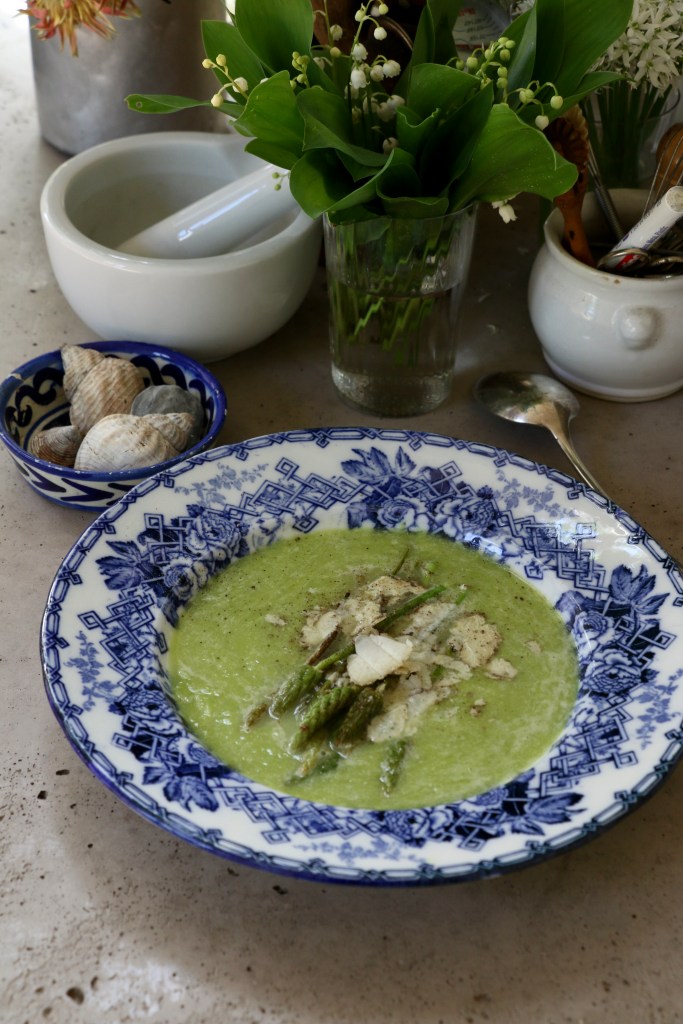
So here’s what I did with the last batch of my wild asparagus. This is a bisque d’asperge sauvage. A bisque traditionally is a soup of crustaceans with pieces of crustacean meat. My version is vegetarian, with pieces of grilled wild asparagus. I also used some Swiss cheese that my mother in law kindly brought me the last time we met, it’s called Bäuper Chnouue, a word that even I am unable to pronounce properly. It’s sort of a bit aged fresh and unpasteurised cow milk cheese rolled in ground pepper and absolutely super perfect to flavour any kind of soup.
What you’ll need
- 500g (approximately, this would probably serve 3-4 as a starter) wild asparagus, foraged by yourself or from a source that you are certain they respect the environment. Brush the asparagus clean, rub any dirt off with a wet cloth and cut out bad parts.
- Fresh water
- Sea salt
- Fresh farm butter
- Bäuper Chnouue or, if not available, replace with a sturdy fresh cheese like a dried fresh goats cheese (or any forgotten piece of fresh cheese in your fridge probably works as well) and finely ground pepper galore
How you cook it
Cut the heads of the asparagus so you end up with about 5cm long pieces, set aside. Put the remaining stems into a wide cooking pan and cover with water, about 750ml. Bring to boil and let simmer for at least 15 minutes.
Melt a teaspoon of butter in a frying pan and fry the asparagus heads crispy, this will take about ten minutes on medium heat. Season with a little sea salt.
When the stems are cooked take off the heat, blend for at least a minute, season with sea salt, add a tablespoon of cold butter and blend for another minute.
Serve the soup in nice plates and garnish with the grilled asparagus heads. Shave some Bäuper Chnouue on top.
How you eat it
Isn’t it wonderful to have lunch without having to resort to a long list of ingredients and no erring through ranges of supermarket isles? To celebrate the occasion you may as well resort to a glass of fresh and springy white wine, some pinot gris from Alsace.


Unfortunately we don’t have wild asparagus here in Northern Ireland but I do love asparagus soup made with some locally grown spears. Now in season .
LikeLike